I’ve taken most every major free enneagram test online, some more than once. Some gave me results that felt instantly right. Others were vague, outdated, or buried the good stuff behind a paywall. This guide is the result of that testing: five free enneagram tests, ranked and reviewed based on accuracy, depth of free results, ease of use, and whether they require your email.
Whether you’re brand new to the enneagram or coming back to validate a type you’ve suspected for years, at least one of these tests will give you something meaningful to work with, for free.
Disclosure: Some links on this page are affiliate links. I may earn a small commission when you click and make a purchase, at no extra cost to you. This does not influence my reviews — I only recommend tests I’ve personally used and trust.
Learning more about your personality and the motives that can influence your behavior is fulfilling and fruitful work. Taking a free enneagram test to help determine your enneagram type is a great place to start. Keep in mind that taking an Enneagram test is just the beginning.
Beth McCord describes the usefulness of the Enneagram in the following way:
The Enneagram accurately and clearly describes why you think, feel, and behave in particular ways based on your core fears and core desires.
The power of the Enneagram is in its ability to harness and transform self-limiting behaviors into life-enhancing personal empowerment.
Be prepared to find rewarding and unsettling things about yourself while using the Enneagram. This is the work of discovery and exploration to help uncover and become the best self you were created to be.
Quick Comparison: All 5 Free Enneagram Tests at a Glance
|
Test |
Time |
Email Required? |
Free Results? |
Wings? |
Best For |
|
10-12 min |
No |
Basic (1 page) |
No |
Most popular; beginner-friendly |
|
|
8-12 min |
No (optional) |
Yes — full type overview |
No |
Best truly free results |
|
|
10-12 min |
Yes |
Basic overview |
No |
Spiritually-oriented users |
|
|
8-12 min |
Yes |
Relationship dynamics |
No |
Teams & workplace use |
|
|
5-7 min |
Yes |
Brief overview |
No |
Quick discovery |
Prefer to watch rather than read? The video below walks through each of these five tests and what to expect from your results.
The Five Best Free Enneagram Tests Online
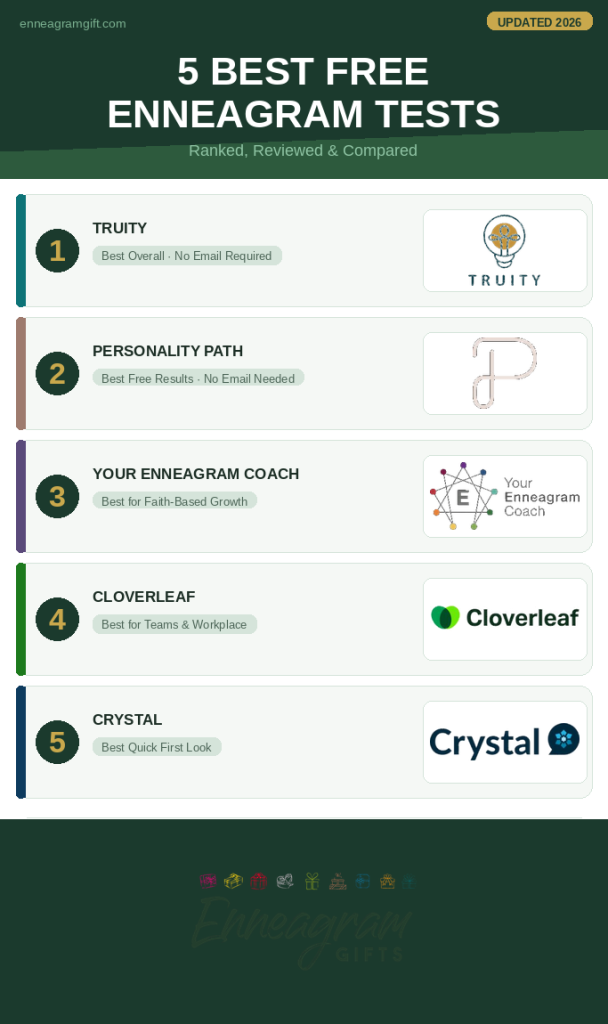
Not all enneagram tests are created equal. The ones listed here come from reputable organizations, have been taken by large numbers of people with consistently favorable feedback, and — most importantly — I’ve taken each one myself. You don’t need to take all five. Start with one or two and compare results.
To learn more details about each test and some of the differences between each one, keep reading below. You’ll find information about the test’s creators, the reports, how long it takes to complete each one, and what it’s like to take each assessment.
1. Truity — Best Overall Free Enneagram Test
Time to complete: 10–12 minutes
Email required: No
Free results: Yes — basic type overview + scores for all 9 types
Cost to upgrade: ~$19 for the full 22-page custom report
Take Truity’s Free Enneagram Test: Click Here!
Truity is the most widely taken enneagram test online — over 10 million people per month use the platform for various personality assessments. Their enneagram test is clean, fast, and requires no email address to see your free results, which is a genuine differentiator.
The questions are straightforward and easy to respond to. They use a sliding agreement scale rather than forced-choice questions, which feels more nuanced than some alternatives. The free results show your top type clearly, give you scores for all 9 types so you can see how you stack up across the board, and include a brief overview of what makes your type tick.
What you won’t get in the free version: your wing, any relationship or career breakdowns, or deep-dive content on your type’s patterns. For that, the paid 22-page report is genuinely thorough — but the free version alone is enough to confirm or identify your type.
Who it’s best for: First-timers who want a quick, polished, no-email experience. Also great if you want to compare your scores across all 9 types visually.
2. Cloverleaf — Best Free Enneagram Test for Teams and Workplace Use
Time to complete: 8–12 minutes
Email required: Yes
Free results: Yes — type overview + relationship dynamics report
Cost to upgrade: Paid team and organizational plans available
Take Cloverleaf’s Free Enneagram Test: Click Here!
Cloverleaf stands out from every other test on this list because it isn’t just about knowing your type — it’s about understanding how your type shows up in relationship to others. The free results include an overview of your type’s communication style, work style, sources of conflict, and reactions to conflict when paired with other types. That relational layer is genuinely useful and isn’t something Truity or Personality Path provides in their free tiers.
The assessment questions themselves are notably different from other enneagram tests — I found them more scenario-based and enjoyable to answer. Cloverleaf describes their mission as helping individuals and teams do their best work, built on the belief that everyone is valuable, the whole person matters, and relationship is everything. That philosophy comes through in how the results are framed.
If you’re interested in using the enneagram in a professional context — with your team, in leadership development, or for understanding workplace dynamics — Cloverleaf is the strongest free starting point. The platform also integrates with tools like Slack and Google Calendar for ongoing team nudges, which is unique in this space.
Who it’s best for: Managers, team leaders, HR professionals, and anyone who wants to understand how their type interacts with others at work. Also worth exploring if your organization is looking for team development tools.
3. Personality Path — Best Free Results Without Email

Time to complete: 8–12 minutes
Email required: No (email is optional for the full report)
Free results: Yes — full type overview + scores for all 9 types
Cost to upgrade: $25 for a comprehensive personal development report
Take Personality Path’s Free Enneagram Test: Click Here!
Personality Path is a newer test, but it’s earned a strong reputation quickly. The creators are deeply committed to the enneagram and subscribe to the ethical guidelines of the The International Enneagram Association — which matters more than it might seem, because it means the test is built with genuine intent to help, not just to capture your email.
What sets Personality Path apart is the quality of the free results page. You don’t need to enter an email address to see your full type overview — you get a clear result with all 9 type scores and a readable explanation of your dominant type right on screen. For users who specifically want free results without any email requirement, this is the top pick.
The questions themselves are reflective and well-crafted. I found them to be more psychologically oriented than some other free options, which can help surface a more accurate result if you tend toward introspection.
Who it’s best for: Anyone searching for a free enneagram test with no email required. Also great as a second opinion alongside Truity.
4. Your Enneagram Coach (Beth McCord) — Best for Spiritually-Oriented Users

Time to complete: 10–12 minutes
Email required: Yes
Free results: Yes — basic type overview
Cost to upgrade: Paid reports and coaching resources available
Take Your Enneagram Coach’s Free Enneagram Test: Click Here!
Beth McCord is one of the most recognized voices in the enneagram space, having been an enneagram speaker, coach, and teacher for over 20 years. Her site — Your Enneagram Coach — brings a distinctly faith-based and spiritually-grounded perspective to the enneagram that you won’t find on more clinical platforms.
This test does require an email address to access your results, which is worth knowing upfront. The free results are a basic type overview rather than a deep breakdown. What the platform does extremely well is the ecosystem around the test: the type explanation pages are thorough and warmly written, and the coaching, training, and certification resources Beth’s team offers make this a strong hub if the enneagram becomes a bigger part of your personal growth journey.
If the spiritual dimension of the enneagram resonates with you — if you want to explore your type through the lens of faith, wholeness, and becoming your best self — this is the right place to land.
Who it’s best for: Spiritually-oriented users, people of faith, and anyone interested in enneagram coaching or certification resources beyond the test itself.
The site also has a very helpful explanation page for each type providing a quick list of each number and a helpful summary. Additionally, her team provides numerous resources to support one journey using the enneagram, including, coaching, training, and certifications.
5. Crystal — Best for a Quick First Look

Time to complete: 5–7 minutes
Email required: Yes
Free results: Yes — brief type overview
Cost to upgrade: Paid plans for deeper personality insights
Take Crystal’s Free Enneagram Test: Click Here!
Crystal is the fastest test on this list, and its approach is genuinely different from the others: rather than relying solely on your self-reported answers, the platform analyzes online data points to build a more rounded personality profile. The enneagram is one component of a broader personality system Crystal uses that also includes DISC profiling.
The free enneagram results are brief — a basic type overview rather than a deep exploration. The site itself is clean and well-designed, and the type content within the enneagram section (descriptions, wing explanations, type compatibility) is solid and easy to navigate.
Crystal is not the place to go if you want deep enneagram content from your free results. It’s better as a fast entry point — a 5-minute way to get a directional result that you can then explore more deeply with one of the other tests above.
Who it’s best for: Users who want a very quick result to get started. Also useful for people already using Crystal for DISC-based work or hiring contexts.
Bonus: IEQ9 — The Best Enneagram Test If You’re Willing to Pay for It
Time to complete: 20–30 minutes
Email required: Yes
Free results: No — this is a paid assessment
Cost: Approximately $45 for an individual report
Read My Full IEQ9 Enneagram Test Review
The IEQ9 (Integrative Enneagram Questionnaire) is the most scientifically robust enneagram assessment available and the one I’d recommend to anyone who wants the most thorough, detailed result possible. It isn’t free — but I’m including it here because if you’ve taken a few free tests and still feel uncertain about your type, the IEQ9 is worth the investment.
Developed by Integrative Enneagram Solutions, the IEQ9 is used widely in professional coaching and organizational development contexts. The full report covers your type, wing, three instinctual variant stackings, centers of intelligence, and levels of integration — a level of detail no free test comes close to matching.
Who it’s best for: Anyone serious about using the enneagram for personal development or professional coaching who wants comprehensive, validated results.
Frequently Asked Questions
What Is The Best Free Enneagram Test?
The best free enneagram test overall is Truity — it’s the most widely taken, requires no email, and provides clear scoring for all 9 types. For users who want the most detailed free results with absolutely no email required, Personality Path is the top alternative. For teams and workplace use, Cloverleaf is in a category of its own.
The honest answer is that no single test is objectively “the best” for every person — it depends on what you want from your results and what you’re willing to share (email or not). That’s why taking two tests and comparing results is often more revealing than taking one.
Are Free Enneagram Tests Accurate?
No self-reporting personality test is 100% accurate — and that’s true for paid tests too. The enneagram in particular is a nuanced system, and how you answer on any given day, in any given season of life, can shift your results. A few things to keep in mind:
The tests on this list are from reputable, established sources. They’re not random quiz-site clickbait. The question design, type descriptions, and result frameworks have been developed by people who take the enneagram seriously. That said, the results should be treated as a starting point for self-reflection, not a final verdict on who you are.
The best approach: take two or three of the tests above, compare your results, then spend time reading the full descriptions for your top 2–3 type candidates. Most people find that one description resonates in a way the others don’t — not just in your best moments, but in your patterns, your fears, and your defaults under stress.
Once you know your type, exploring how each type behaves in stress and growth and the childhood wound associated with your type will deepen your understanding significantly more than any test result alone.
10 Tips for Getting More Accurate Enneagram Test Results
- Answer for your whole life, not just recently. The enneagram is about lifelong patterns, not your current season. Think about how you’ve consistently been across different life stages.
- Be honest, not aspirational. Answer based on how you actually are, not how you wish you were or how you’re trying to be.
- Avoid neutral answers when possible. Sitting in the middle on every question flattens your results. When in doubt, lean toward the answer that feels more like you.
- Take your time. Don’t rush through. Some questions are designed to surface subconscious patterns — a few seconds of genuine reflection matters.
- Take 2–3 tests and compare. Different question formats surface different aspects of your personality. Cross-referencing results from Truity and Eclectic Energies, for example, is more revealing than relying on one alone.
- Read the full type descriptions for your top 2–3 results. The description you recognize most — including the unflattering parts — is usually your type.
- Pay attention to the core fear and core desire of each type, not just the surface traits. The motivations underneath the behavior are what the enneagram is really mapping.
- Ask people who know you well. A close friend or partner familiar with the enneagram can sometimes identify your type faster than you can — we have blind spots about ourselves.
- Your type may not be the one you want it to be. Many people resist their actual type because it reveals something uncomfortable. That resistance is often a clue.
- Be patient with the process. Some people identify their type immediately. Others take months of reading and reflection. Both are normal.
What to Do Once You Know Your Type
Your test result is the beginning, not the destination. Here are the best next steps once you have a type in hand:
- Learn how your type behaves under stress and in growth — the enneagram stress and growth lines reveal patterns most people recognize immediately.
- Explore your type’s childhood wound — understanding the core wound behind each enneagram type adds a layer of self-compassion that transforms how you use the enneagram.
- Understand your wing — your enneagram wing is the adjacent type that flavors your core type in meaningful ways.
- Explore careers through your type lens — our guide to enneagram careers breaks down strengths, blind spots, and fits for each type.
- Look for gifts suited to your type — if someone in your life has just discovered their type, our enneagram gift guides have curated ideas for every number.
The enneagram is a tool for self-discovery and compassion — for yourself and for the people around you. As Ian Cron puts it: “The Enneagram is a tool that helps us awaken self-compassion and compassion for others.” Whatever your type, the goal is growth — not a label.
New to the Enneagram? A Quick Guide to All 9 Types
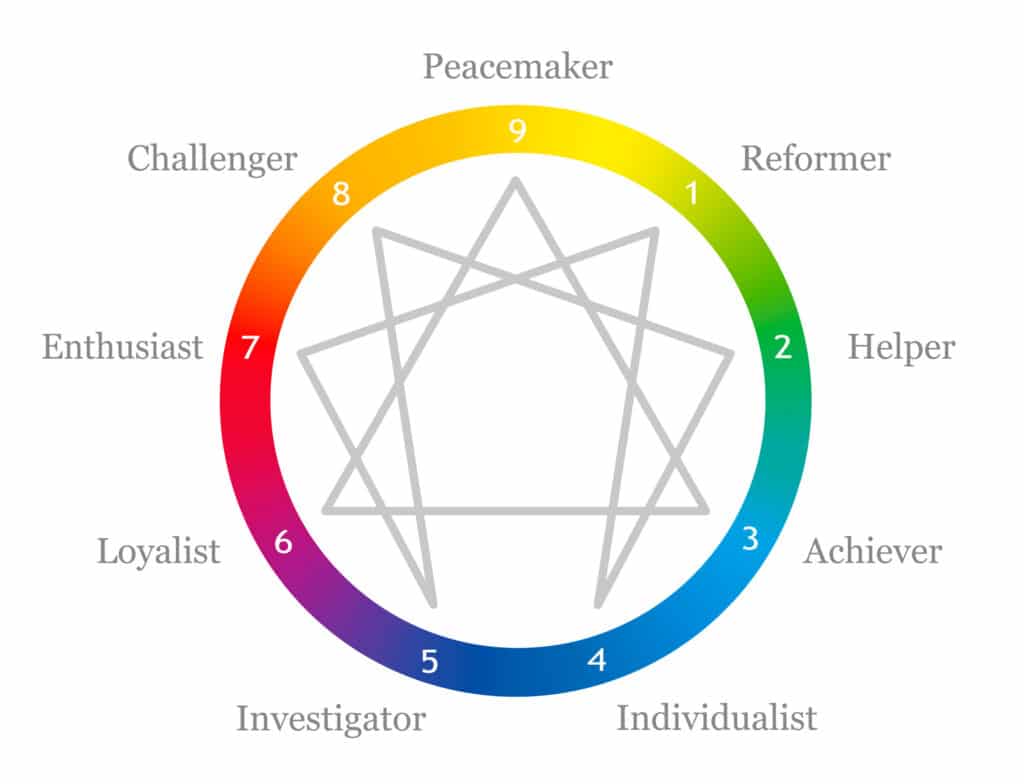
If you’ve just discovered your type and want a quick reference, here’s a brief overview of each of the nine enneagram types. Click any type to explore a full description.
Type 1 — The Perfectionist Core desire: to be good and to uphold high standards. Core fear: moral imperfection or corruption. Ones are principled, purposeful, and self-disciplined, with a deep drive to improve themselves and the world around them.
Type 2 — The Helper Core desire: to be loved and to feel needed. Core fear: being unlovable or unwanted. Twos are warm, generous, and attuned to the needs of others, though they can struggle to acknowledge their own needs in return.
Type 3 — The Achiever Core desire: to feel valuable and successful. Core fear: failure and worthlessness. Threes are driven, adaptable, and achievement-oriented, able to read any room and present themselves effectively — sometimes at the cost of authenticity.
Type 4 — The Individualist Core desire: to be uniquely themselves and to find deep meaning. Core fear: being ordinary or without significance. Fours are creative, emotionally deep, and intensely self-aware, drawn to beauty and authenticity in all its forms.
Type 5 — The Investigator Core desire: to be competent and knowledgeable. Core fear: being helpless, useless, or incompetent. Fives are perceptive, independent, and intellectually curious, often preferring solitude and deep expertise over surface-level social engagement.
Type 6 — The Loyalist Core desire: security, support, and certainty. Core fear: being without guidance, support, or feeling unsafe. Sixes are reliable, responsible, and deeply loyal — and can range from cautiously skeptical to anxiously vigilant depending on their stress level.
Type 7 — The Enthusiast Core desire: to be happy, satisfied, and free from pain. Core fear: deprivation and suffering. Sevens are spontaneous, optimistic, and endlessly curious, with a gift for reframing difficulty — and a tendency to keep moving before discomfort fully lands.
Type 8 — The Challenger Core desire: to protect themselves and others; to be in control of their own life. Core fear: being controlled or harmed by others. Eights are confident, decisive, and fiercely protective of the people they love — and can struggle with vulnerability.
Type 9 — The Peacemaker Core desire: inner peace and harmony in their world. Core fear: conflict, loss, and disconnection. Nines are accepting, steady, and gifted at seeing all sides of a situation — and can sometimes lose themselves in the process of keeping everyone else comfortable.
Looking for more enneagram resources? You might also enjoy: